Life on the Moon
The First Man on the MoonNeil ArmstrongArmstrong was born in Wapakoneta, Ohio, on Aug. 5, 1930. His parents were Stephen Koenig Armstrong and Viola Louise Engel. Armstrong was a naval aviator from 1949 to 1952 and served in the Korean War. Armstrong got a bachelor of science degree in aeronautical engineering from Purdue University in 1955; much later (after he became world-famous) he received a master of science in aerospace engineering from the University of Southern California in 1970. As a NASA test pilot, Armstrong flew the X-15, a rocket-powered, missile-shaped aircraft that tested the limits of high-altitude flight. He flew more than 200 different aircraft, from jets to gliders and even helicopters.
In 1962, Armstrong was selected with NASA's second group of astronauts, who flew on the two-seat Gemini missions to test out space technology, and the three-seat Apollo missions that ultimately took 12 people to the surface of the moon. Armstrong's first flight was the command pilot of the Gemini 8 mission in March 1966, the sixth crewed mission of that series.
Armstrong and pilot David Scott did the first orbital docking of two spacecraft, joining their Gemini 8 spacecraft to an uncrewed Agena target vehicle. However, the mission quickly turned into an emergency situation when a thruster on the Gemini 8 spacecraft was stuck open. With the astronauts whipping around faster than one revolution per second, Armstrong managed to gain control again by using the re-entry system thrusters. The mission — the first serious emergency in space — ultimately ended safely, but splashed down early because the re-entry system was used.
Armstrong narrowly avoided a nasty accident in May 1968 while using the Lunar Landing Research Vehicle, a machine that could fly somewhat like a lunar module and simulate landings on the moon. Fuel for his thrusters ran out and Armstrong was forced to eject just seconds before the vehicle crashed. Armstrong escaped unharmed.
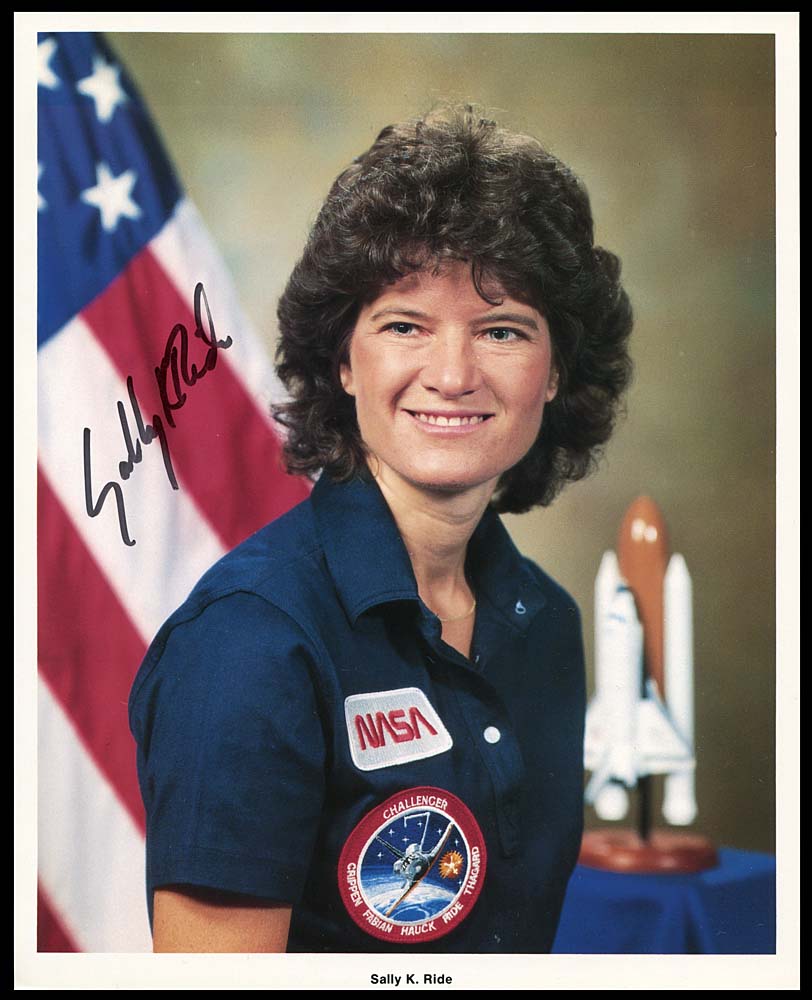
The First Woman on the MoonSally Ride
Sally Ride became the first American woman to go into space when she flew on the space shuttle Challenger on June 18, 1983. She made two shuttle flights, and later became a champion for science education and a role model for generations. Ride died of cancer in 2012.
Encouraged to explore
Born in Encino, Calif., on May 26, 1951, Sally Kristen Ride was the older of two daughters of Dale B. Ride and Carol Joyce (Anderson) Ride. Her father was a professor of political science and her mother was a counselor. While neither had a background in the physical sciences, she credited them with fostering her deep interest in science by encouraging her to explore.
An athletic youngster, Ride attended Westlake High School for Girls, a prep school in Los Angeles, on a partial tennis scholarship. She graduated in 1968. After a brief foray into professional tennis, she returned to California to attend Stanford University. There she received a bachelor of science degree in physics and a bachelor of arts degree in English in 1973. Furthering her studies at Stanford, she obtained a master of science degree in 1975 and a doctorate in physics in 1978, according to a NASA biography of Ride.
After completing her studies at Stanford, Ride applied to the National Aeronautics and Space Administration (NASA). Besting thousands of applicants, Ride was selected as one of NASA's first six female astronauts and began spaceflight training in 1978.
Ride started her aeronautics career on the ground, serving as a capsule communicator (CAPCOM) as part of the ground-support crew for the second (November 1981) and third (March 1982) shuttle flights.
At 32, Ride experienced her first spaceflight as a mission specialist on STS-7, NASA's seventh shuttle mission, aboard the space shuttle Challenger. The mission launched on June 18, 1983, and returned to Earth on June 24. Tasks on the mission included launching communications satellites for Canada and Indonesia. The astronauts also conducted the first successful satellite deployment and retrieval in space using the shuttle's robotic arm. During the flight, Ride became the first woman to operate the shuttle's robotic arm.
Ride's history-making Challenger mission was not her only spaceflight. She also became the first American woman to travel to space a second time when she launched on another Challenger mission, STS-41-G, on Oct. 5, 1984. That mission lasted nine days. On that flight, she used the shuttle's robotic arm to remove ice from the shuttle's exterior and to readjust a radar antenna. Ride was assigned to a third shuttle mission, but her crew's training was cut short by the Challenger disaster in January 1986.